|
ARTICLES
[an error occurred while processing this directive]
|
When you were a kid, did
you ever sit in your math class and ask "When the heck am I ever going
to use this?" Did algebra and trigonometry seem pointless?
Would math seem more useful if it could help you build RC
airplanes? I use a little bit of trigonometry and algebra to
figure out where to place my engine when the plans call for a certain
amount of right thrust. Let's say you're building a plane, and you drill your firewall to center the engine mount in the middle. Then you notice that the plans call for 3 degrees of right thrust, so you shim the left side of the mount. Guess what? The center of your propeller is now noticeably offset to the right. I hate it when that happens. It just doesn't look right.  Instead, I like to calculate how far to one side the propeller shaft is going to land, then move the back of the engine the same distance in the other direction. That way the propeller will be centered! 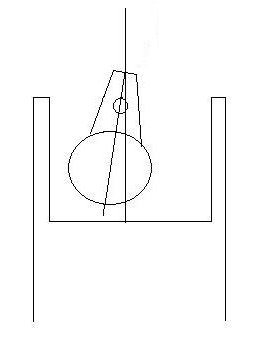 It's not a hard calculation to do, and a scientific calculator makes it even easier. The trigonometric function of the Sine tells us that the sine of an angle = length of opposite side divided by the hypotenuse (S=O/H) Here's a diagram showing the centerline of the airplane as one side of a right triangle and the centerline of the engine as the hypotenuse. (For those of you who really don't remember your math classes, the hypotenuse is the longest side of a right triangle, across from the 90 degree angle.)  Let's say your engine and mount are 4 inches long from the firewall to the back of the propeller. X is the distance you will offset your mount to the left. According to the trigonometry book, the sine of 3 degrees = X/4 inches. Punch some buttons on your calculator (or windows calculator on your computer) and you'll find that Sin3=.0523. Therefore .0523=X/4. If you remember your algebra lessons, you know that whenever you have an equation (with the = sign in the middle), it means that both sides of the = sign represent the same number, so you can add, subtract, multiply or divide any number, as long as you do it to both sides. Multiply both sides of the equation by 4, and you get: 4 times .0523 = X In other words, the length of the little line in our diagram equals approximately .21 inch, or just a hair less than 1/4". So, you drill your engine mount holes just a little less than a quarter of an inch to the left of the centerline. When you shim your mount to get your engine to point 3 degrees to the right, the center of the propeller shaft will land right on the centerline of the airplane. To simplify things even more, here's an equation using RC terms that will be easy to remember. All you need to know is the amount of right thrust and the length of your engine from the back of the mount to the center of the propeller. The sine of the thrust angle times the length of the engine = the amount of offset to the left. Just to make sure you see how easy this is, let's say you have a big four stroke with a big propeller going on a biplane. (This setup would need a lot of offset, by the way.) This is a 1.20 four stroke, so the engine and mount assembly is 6 inches long. We're going to use a 6 degree offset to the right, which would make the engine look ridiculous if we didn't offset the mount the other direction on the firewall. All we have to do is multiply the sine of 6 degrees by the length of the engine and mount, which is 6 inches. The little brain in my computer tells me that the sine of 6 degrees is .104, which gives me .627" when I multiply by 6 inches. That's 5/8" to the left of the centerline. My high school algebra teacher would be proud! |